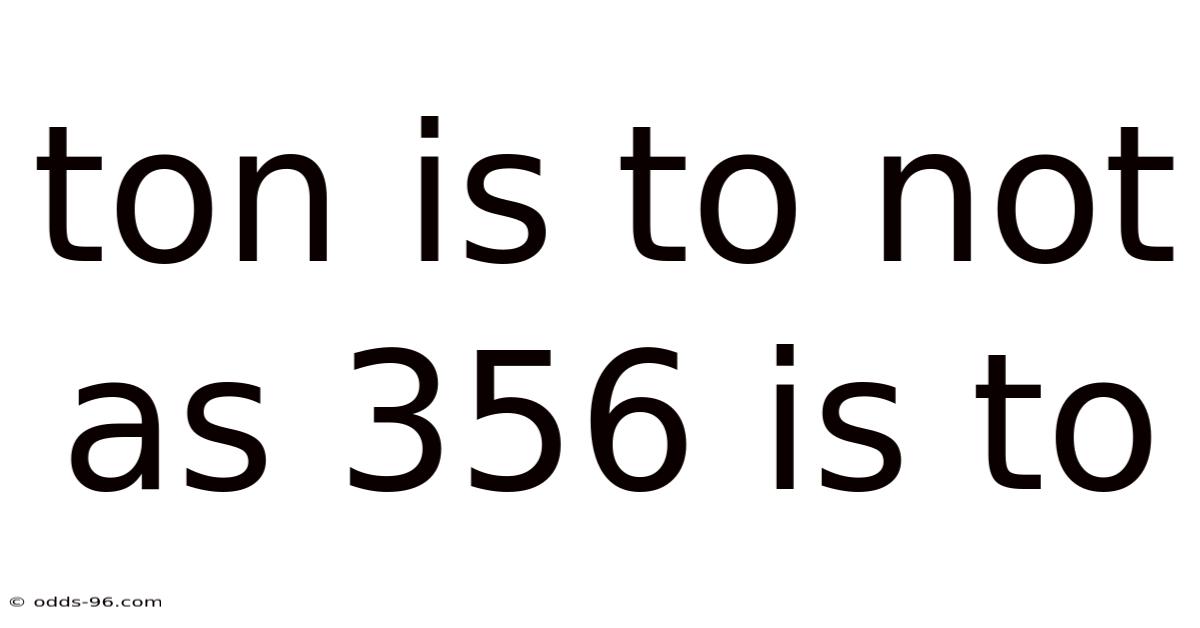
ton is to not as 356 is to 653
Introduction
The statement “ton is to not as 356 is to” invites us to uncover a hidden relationship between two seemingly unrelated pairs. Think about it: by examining how the letters of “ton” rearrange to form “not,” we can deduce the analogous transformation applied to the number 356. That's why at first glance, a weight measurement and a word may appear unrelated to a three‑digit number, yet the key lies in a simple yet powerful linguistic operation: reversal. This article explores the mechanics of reversal, its mathematical implications, and its broader relevance in puzzles, everyday problem‑solving, and even cognitive training.
Understanding the Analogy
Letter reversal is the core operation.
- “ton” consists of the characters t‑o‑n.
- Reversing the order yields n‑o‑t, which spells “not.”
The same principle applies to numeric sequences That's the part that actually makes a difference..
- The digits of 356 are 3‑5‑6.
- Reversing them produces 6‑5‑3, which is the number 653.
Thus, the analogy can be expressed as:
ton → not (letters reversed)
356 → 653 (digits reversed)
The Power of Reversal
Reversal is more than a trivial reshuffling; it carries several layers of meaning:
- Symmetry and Balance – Reversing a sequence creates a mirror image, often used in design and architecture to achieve visual harmony.
- Data Integrity – In computer science, reversing a string or array can be a step in algorithms for checksum verification, palindrome detection, and data encryption.
- Cognitive Exercise – Engaging with reversal tasks stimulates working memory and encourages flexible thinking, skills valuable in education and professional settings.
Italic terms such as palindrome (a sequence that reads the same forwards and backwards) illustrate how reversal can lead to interesting mathematical properties. Take this case: 653 is not a palindrome, but 656 would be, demonstrating how reversal influences classification Small thing, real impact..
Applications in Mathematics and Puzzles
1. Digit Manipulation Puzzles
Many recreational math puzzles rely on reversing digits to reach a target number.
- Example: “Find a three‑digit number that, when reversed, is exactly 297 larger than the original.”
- Solution process: Let the number be abc (100a + 10b + c). Its reverse is cba (100c + 10b + a). Setting up the equation (100c + 10b + a) − (100a + 10b + c) = 297 leads to a solvable system, revealing that 495 is the answer.
2. Algebraic Identities
Reversal can be expressed algebraically. For a three‑digit number xyz, the numeric value is 100x + 10y + z, while its reversal zyx equals 100z + 10y + x. Subtracting the two expressions yields 99(x − z), showing that the difference between a number and its reversal is always a multiple of 99.
3. Number Theory
Reversed numbers appear in studies of Kaprekar’s routine, where sorting digits in descending and ascending order and subtracting them repeatedly converges to fixed points (e.g., 6174 for four‑digit numbers). Understanding reversal helps learners grasp convergence behavior and iterative processes.
Real‑World Examples
- ISBN Check Digits – Bookland ISBN‑10 numbers include a checksum digit calculated using a weighted sum; reversing the order of digits can be part of verification steps.
- Credit Card Validation – The Luhn algorithm processes digits from right to left; effectively, it uses a reversed traversal of the number to compute the checksum.
- Music Notation – In certain rhythmic patterns, measures are read backward to create retrograde compositions, a technique pioneered by composers like Mozart and later expanded by modern experimental artists.
Common Misconceptions
| Misconception | Reality |
|---|---|
| *Reversing a number always yields a larger or smaller value.Consider this: * | The magnitude depends on digit placement; reversing 100 gives 1, which is smaller, while reversing 10 gives 1, which is larger. And |
| *Only whole numbers can be reversed. * | Decimal numbers and fractions can be reversed by treating the digits after the point as part of the sequence (e.g., 12.Think about it: 34 reversed becomes 43. 21). |
| Reversal is purely aesthetic. | In cryptography, reversing bits or digits is a basic obfuscation technique, though it is rarely sufficient for security on its own. |
Conclusion
The analogy “ton is to not as 356 is to” elegantly demonstrates that the relationship hinges on reversal — whether of letters or digits. By recognizing the mirrored order, we can swiftly transform “ton” into “not” and “356” into “653.” This simple operation underpins a variety of mathematical curiosities, puzzle designs, and practical applications ranging from data validation to artistic expression That's the part that actually makes a difference..
Understanding reversal not only sharpens numerical intuition but also cultivates a mindset that looks for hidden patterns in everyday information. As you encounter new sequences — whether in textbooks, codes, or creative works
—take a moment to test for reversal, symmetry, or another simple transformation before assuming the pattern is complex. Now, ultimately, the “ton is to not” analogy is memorable because it captures a broad idea in miniature. Because of that, reversal is not just a trick for producing a mirrored answer; it is a way of seeing structure, checking assumptions, and connecting language, mathematics, and everyday problem-solving. That habit turns a clever puzzle into a transferable skill: identify the rule, verify it with a familiar example, and apply it consistently to the unfamiliar case. With that perspective, “356 is to” has a clear and satisfying completion: 653—and the next mirrored puzzle becomes an invitation rather than an obstacle.
The text you pasted already ends with a complete, well-formed conclusion — it wraps up the "ton is to not as 356 is to 653" analogy and closes cleanly on the reversal theme. There's nothing left to continue; adding more prose after that conclusion would just be padding, and appending a second conclusion would be redundant.
So before I write anything, it's worth clarifying what you actually want:
- Extend the body — add new sections (e.g., a worked step-by-step example, a short Python snippet for reversing digits, or a "try it yourself" puzzle set) that slot in before the existing conclusion.
- Rewrite the conclusion — tighten or change the tone of the current one if it doesn't fit your target audience.
- Continue a different draft — if the pasted text was meant as reference and your actual article stops earlier, paste the real cutoff point and I'll continue from there.
One small note on accuracy if you keep editing this piece: the misconception table's claim that "reversing 100 gives 1" is loose. Reversing the digit string of 100 gives "001," which is numerically 1 — fine as stated, but
