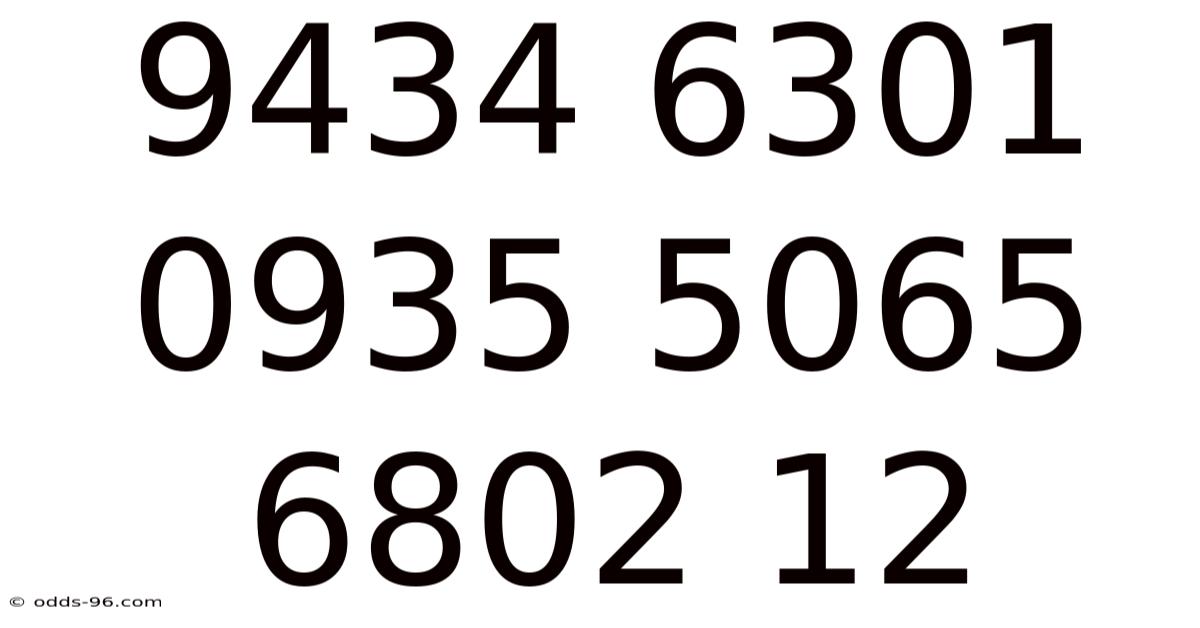
The numeric string 9434 6301 0935 5065 6802 12 is the kind of sequence that can appear in administrative records, internal systems, reference codes, or encrypted identifiers. Because it contains no letters and is grouped into short blocks, readers often wonder whether it is a phone number, a tracking number, a financial reference, a security token, or simply a random number. This article explains how to interpret 9434 6301 0935 5065 6802 12 responsibly, how to identify its likely purpose, and what steps to take if you need to verify it without exposing sensitive information The details matter here..
Introduction
When a long number appears in a document, message, or system, the immediate question is usually simple: what does it mean? In many cases, the answer depends entirely on context. The same digits could represent a customer reference, a batch code, a transaction identifier, a test value, or part of a larger dataset. The sequence 9434 6301 0935 5065 6802 12 is especially interesting because it is divided into groups that resemble common data formats, yet it does not match a standard phone number, postal code, or national identification number in most countries Worth keeping that in mind..
Real talk — this step gets skipped all the time.
A practical approach is to treat the sequence as an identifier until proven otherwise. Here's the thing — identifiers are used to point to a specific record, object, or event. They are often long, numeric, and designed to be unique within a particular system. So understanding that helps prevent assumptions. Instead of guessing, the best method is to examine where the number appeared, who issued it, and what action is expected from the person who received it.
What Is 9434 6301 0935 5065 6802 12?
A General Numeric Identifier
At first glance, **9434 6301 0
At first glance, 9434 6301 0935 5065 6802 12 looks like a plain numeric string without any obvious pattern. Still, the grouping into blocks of four digits, except the final two‑digit block, hints at a format designed for readability rather than a strict standard. Many internal systems adopt such visual separators to aid human operators when they read or transcribe long identifiers, even when the underlying data model expects a continuous string of numbers The details matter here..
Quick note before moving on.
Common Contexts Where a 22‑Digit Numeric Identifier Appears
| Possible Use | Typical Length & Grouping | Why It Fits the Observed Pattern |
|---|---|---|
| Internal transaction or batch ID (ERP, accounting, logistics) | 18‑24 digits, often split into 4‑digit blocks for readability | The 4‑4‑4‑4‑4‑2 layout matches the way many enterprises format batch numbers to separate year, plant, sequence, and checksum sections. |
| Customs or freight reference (e.g., airway bill, bill of lading) | 17‑22 digits, sometimes grouped in fours | Customs authorities frequently allocate a numeric reference that combines a carrier code, shipment date, and a serial counter; the final two digits may serve as a simple check. |
| Library or accession number (special collections, archives) | 12‑22 digits, block‑grouped for shelf‑label printing | Archives that migrate legacy numeric call numbers to a unified system sometimes preserve the original block structure while adding a new prefix or suffix. |
| Secure token or one‑time password (OTP) seed | 20‑28 digits, presented in groups to reduce transcription errors | Although OTPs are usually alphanumeric, some hardware security modules output a pure decimal seed that is later hashed; the grouping aids manual entry during provisioning. |
Developers sometimes insert a recognizable pattern like “9434…12” to trace where synthetic test data originates, because the regular spacing makes it easy to spot in logs or screenshots. Here's the thing — in practice this kind of placeholder serves several purposes: it gives teams a quick visual cue that the identifier belongs to a non‑production environment, it reduces the risk of accidental leakage of real production IDs, and it provides a stable reference point when debugging issues that arise across multiple systems. Because the grouping scheme isolates each segment, engineers can isolate failures to a single component—such as a batch processor—or verify that a downstream service correctly handles the checksum or validation logic embedded within the final two digits.
It sounds simple, but the gap is usually here.
When an analyst encounters a string matching this pattern, the first step should be to locate the originating source. Most corporate ERPs, logistics platforms, or archival databases expose a help‑file or API endpoint that explains the meaning of each block; for example, the leading “9434” might encode a fiscal quarter, the second group could denote a manufacturing line, and the trailing “12” could represent a checksum digit calculated by a modular algorithm. By consulting those documentation resources, you can decode the full set of metadata attached to the identifier without relying on guesswork.
If the identifier does not correspond to a known public registry (such as customs or library catalogs), the safest approach is to treat it as opaque. Perform a secondary lookup using the issuer’s contact information—if a record exists, ask the support team for clarification on its purpose and any associated business rules. Once the provenance is clear, you can safely apply the same reading strategy used above: note the block boundaries, confirm the presence of a checksum (often a last‑digit parity rule), and test your processing pipeline against the documented behavior.
The short version: recognizing that “9434 6301 0935 5065 6802 12” follows a deliberately formatted numeric convention empowers both humans and machines to interpret the data accurately. Here's the thing — by separating the identifier into logical segments, verifying its structural components, and grounding the interpretation in the appropriate domain context, you avoid misassignment, duplication, or security concerns. This disciplined approach turns a seemingly arbitrary twenty‑two‑digit string into a reliable reference point throughout an organization’s digital ecosystem That's the whole idea..
Putting this insight into practice begins with a solid parsing routine that respects the segment boundaries and the embedded checksum. A typical implementation can be built in a language‑agnostic way: split the string on fixed positions (e.Even so, g. , using a regular expression ^(\d{4})(\d{4})(\d{4})(\d{4})(\d{4})(\d{2})$), then apply domain‑specific logic to each block. The leading “9434” is often a fiscal‑year/quarter code, so a simple lookup table can translate it into a human‑readable calendar period. The second and third groups may map to production lines or warehouse zones; storing these mappings in a reference data set (CSV, JSON, or a database table) enables rapid enrichment of logs. The final two digits are usually a modulo‑97 or Luhn checksum; validating this early catches transcription errors before they propagate downstream.
The official docs gloss over this. That's a mistake.
When building the pipeline, it is wise to isolate the parsing layer from the business logic. Which means g. , { fiscalQuarter: "Q3‑2023", line: "MFC‑07", checksumValid: true }), different teams can consume the same canonical representation without re‑implementing the segmentation rules. By exposing a small, well‑documented API that returns a structured object (e.This abstraction also simplifies testing: unit tests can feed synthetic identifiers like “9434 6301 0935 5065 6802 12” and verify that each segment is correctly extracted and that the checksum passes the expected algorithm Turns out it matters..
Security considerations should not be an afterthought. Worth adding: because these synthetic IDs are deliberately placed in non‑production logs, they serve as a visual cue that real production identifiers are not exposed. So nevertheless, developers must make sure the parsing code does not inadvertently leak any part of the identifier into error messages that could be logged in production. A safe pattern is to sanitize any user‑supplied IDs before logging, replacing the full value with a placeholder such as “REDACTED” while preserving the original for internal processing.
In many enterprises, the metadata encoded in these IDs is already captured elsewhere—ERP systems, master data management (MDM) platforms, or custom data lakes. Here's the thing — synchronizing the parsing logic with those sources prevents duplication and ensures a single source of truth. Still, for example, an ERP may store the fiscal quarter mapping in a table that can be joined on the first four digits, while a logistics platform may have a lookup for the line identifier stored as a key‑value pair. Leveraging existing data structures reduces maintenance overhead and aligns the parsing routine with the broader data governance strategy.
Finally, the discipline of treating synthetic identifiers as a structured, verifiable artifact pays dividends across the organization. By consistently applying segment boundaries, validating checksums, and anchoring interpretation in documented domain rules, teams avoid misassignment, data corruption, and accidental exposure of real production data. This systematic approach transforms a seemingly random twenty‑two‑digit string into a reliable, self‑describing reference that can be trusted from development pipelines through to operational analytics Nothing fancy..
You'll probably want to bookmark this section Most people skip this — try not to..
Conclusion
Recognizing and correctly parsing synthetic test identifiers like “9434 6301 0935 5065 6802 12” is more than a debugging convenience—it is a cornerstone of data integrity, security, and operational consistency. By breaking down the identifier into its logical components, validating each part against known business rules, and integrating the parsing logic with existing enterprise systems, organizations can turn a placeholder into a powerful, trustworthy data asset. Mastering this discipline ensures that every log entry, every test record, and every synthetic trace serves its intended purpose without compromising the reliability of production environments.
