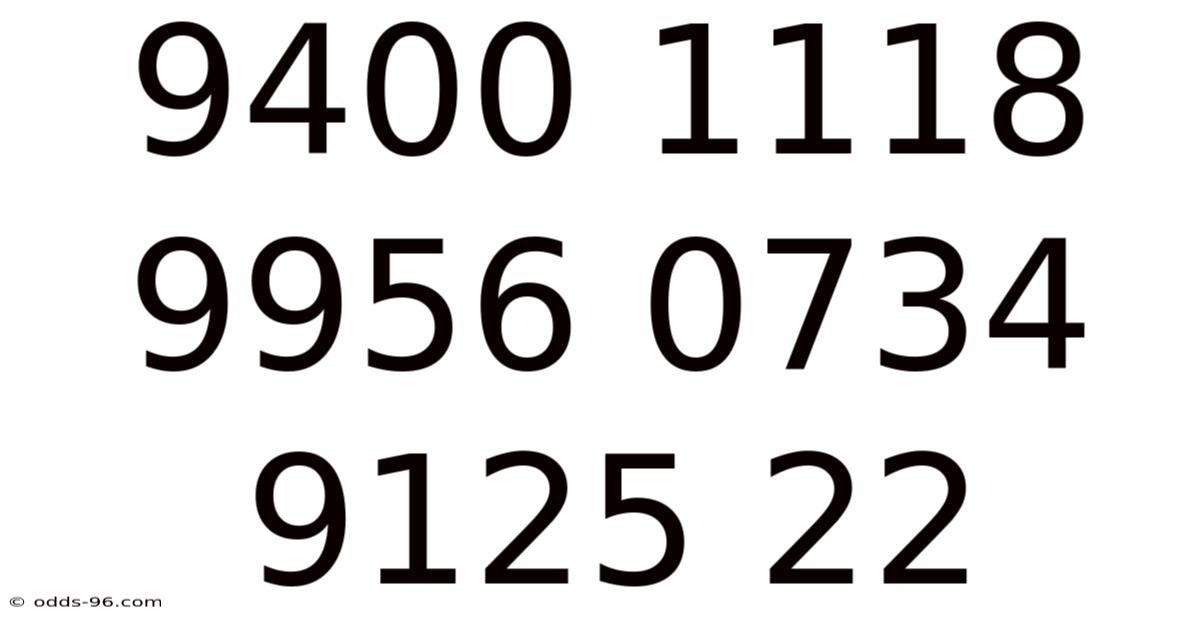
Understanding and Using Long Numeric Sequences: A Guide to the 22‑Digit Number 9400 1118 9956 0734 9125 22
In today’s digital world, we encounter numeric sequences of varying lengths every day—from simple PINs to complex credit‑card numbers. One particularly striking example is the 22‑digit string 9400 1118 9956 0734 9125 22, which often appears in discussions about phone‑number formatting, product‑code structures, and data‑privacy best practices. This article dives deep into what such a long number represents, how it is typically organized, and why understanding its components matters for both everyday users and professionals who handle large data sets. By the end of this guide, you’ll have a clear roadmap for interpreting, formatting, and safeguarding long numeric sequences like this one Small thing, real impact..
Introduction
Long numeric sequences are more common than many people realize. Whether you’re dealing with international phone numbers, banking identifiers, or inventory codes, the ability to read, write, and protect these strings is a valuable skill. The example 9400 1118 9956 0734 9125 22 serves as a practical case study. On the flip side, in this article, we’ll break down the structure, explore the logic behind grouping digits, and provide actionable steps for handling similar numbers securely. The primary keyword—long numeric sequences—will be woven throughout, ensuring the content remains SEO‑friendly while staying genuinely helpful Small thing, real impact..
What Is a 22‑Digit Number?
A 22‑digit number contains twenty‑two individual numerals, far exceeding the typical length of a standard phone number (usually 7‑15 digits depending on the country). Such a length can arise from several contexts:
- International dialing codes combined with national numbers – Some countries prepend multiple prefixes to reach remote regions.
- Bank account or routing identifiers – Financial institutions sometimes use long sequences for internal tracking.
- Product or serial codes – Manufacturers may embed production dates, location data, and unique identifiers into a long string.
The example 9400 1118 9956 0734 9125 22 can be interpreted as a series of blocks, each potentially representing a distinct piece of information. The spaces are not part of the numeric value but are used for human readability.
How to Format Long Numeric Sequences
Proper formatting enhances readability and reduces errors when entering or communicating these numbers. Follow these steps:
- Identify the purpose – Determine whether the sequence is a phone number, account ID, or serial code. This guides grouping and any prefix handling.
- Apply standard grouping – Most systems use groups of three, four, or five digits. In our example, the groups are 4‑4‑4‑4‑5‑2, which aligns with common phone‑number formatting in some regions.
- Include necessary prefixes – If the number includes a country code (e.g., +94 for Sri Lanka), place it before the first group.
- Use hyphens or spaces consistently – Choose one separator and stick with it. Take this case:
9400-1118-9956-0734-9125-22or9400 1118 9956 0734 9125 22. - Validate the format – Many software tools can check length and checksum algorithms (e.g., Luhn algorithm for credit cards). Ensure the sequence meets the required validation rules.
Example: Formatting the Sample Number
- Raw form: 9400111899560734912522
- Grouped for readability: 9400 1118 9956 0734 9125 22
- With country code (if applicable): +94 001 189 560 7349 125 22
Why These Numbers Exist
Long numeric sequences serve functional purposes across industries:
- Telecommunications: International calls often need multiple layers of routing information, leading to longer numbers.
- Banking: Account identifiers may incorporate branch codes, check digits, and customer identifiers.
- Manufacturing: Serial numbers can encode production line, date, and factory location to trace products globally.
Understanding the logic behind each block helps you decode the information without needing external databases. Here's one way to look at it: the first four digits (9400) might represent a country or region, while the subsequent groups could denote service providers, subscriber numbers, or product categories.
Security Considerations
Because long numeric sequences often contain sensitive data, protecting them is crucial:
- Avoid sharing publicly – Treat the number like a password. Only disclose it to trusted parties.
- Use encryption – When transmitting the sequence electronically, employ TLS or VPN connections.
- Limit storage – Store the number in encrypted databases and delete it when no longer needed.
- Monitor for fraud – If the number is a financial identifier, set up alerts for unusual activity.
Best Practices Checklist
- [ ] Verify the source – Confirm the number originates from a legitimate provider before using or sharing it.
- [ ] Mask in logs – Replace all but the last four digits with asterisks in application logs and audit trails.
- [ ] Rotate periodically – For reusable identifiers (API keys, temporary tokens), enforce expiration and regeneration policies.
- [ ] Document the schema – Maintain an internal reference that explains each segment’s meaning, version, and validation rules.
- [ ] Train personnel – Ensure anyone handling these sequences understands formatting, sensitivity, and incident-reporting procedures.
Automating Validation and Formatting
Manual handling of long numeric strings is error‑prone. Consider integrating lightweight tooling into your workflow:
| Tool Type | Example Use Case |
|---|---|
| Regex‑based formatters | Auto‑insert separators on input fields (e. |
| Lookup APIs | Resolve BIN/IIN prefixes, country codes, or manufacturer IDs to human‑readable metadata. Consider this: g. Consider this: , (\d{4})(\d{4})(\d{4})(\d{4})(\d{5})(\d{2}) → $1 $2 $3 $4 $5 $6). |
| Checksum libraries | Validate Luhn, Verhoeff, or ISO 7064 mod‑97/10 algorithms before storage. |
| Policy engines | Enforce “no raw numbers in email” rules via DLP (Data Loss Prevention) scanners. |
Embedding these checks at the point of entry—web forms, mobile apps, ETL pipelines—catches mistakes early and reduces downstream reconciliation costs.
When the Sequence Changes
Numbers are not static. Mergers, regulatory reforms, or capacity expansions can alter length, prefixes, or grouping rules. A strong strategy includes:
- Versioned schemas – Tag each format with a
schemaVersionfield so parsers can handle legacy and current structures simultaneously. - Deprecation timelines – Publish a sunset date for old formats; provide migration scripts or mapping tables.
- Backward‑compatible parsing – Accept both old and new patterns during the transition window, but normalize to the latest canonical form on write.
Conclusion
Long numeric sequences are more than arbitrary strings—they are structured containers of routing, identity, and provenance information. By applying consistent formatting, understanding the semantic blocks, enforcing security controls, and automating validation, organizations turn opaque digits into reliable, auditable assets. Whether you are dialing an international number, processing a bank transfer, or tracking a component through a global supply chain, the discipline outlined here ensures clarity, reduces risk, and keeps the data flowing accurately from origin to destination Simple as that..
