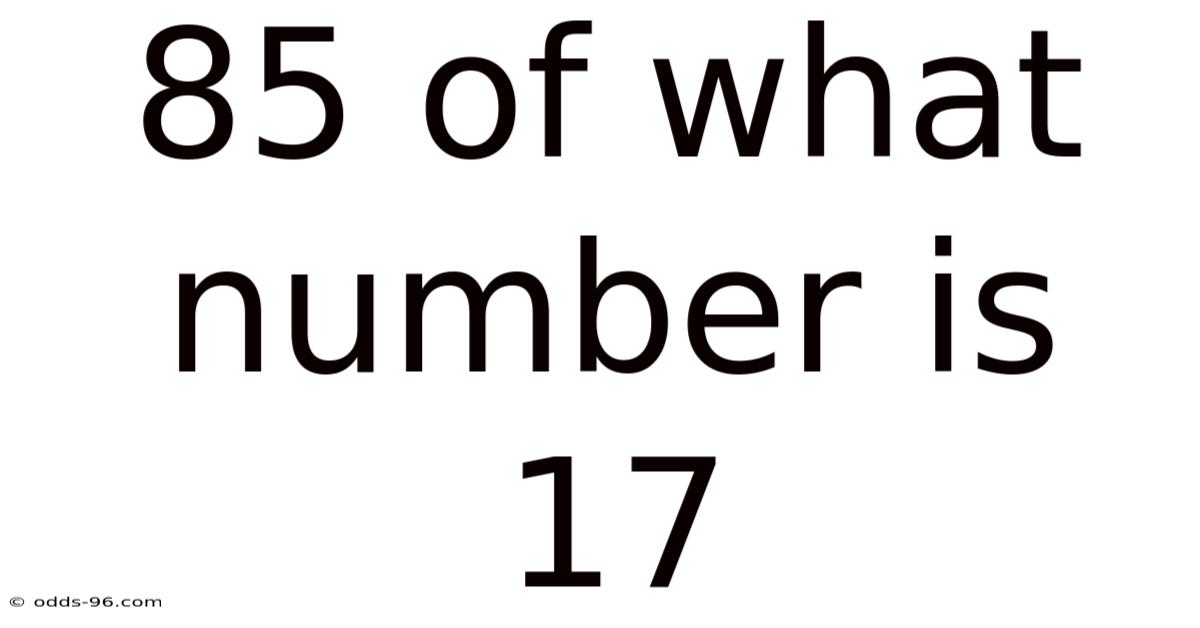
When students encounter the question "85 of what number is 17," they are often looking for a clear, step-by-step explanation of how to find the whole when given a part and its percentage. Still, this type of percentage problem appears frequently in mathematics, finance, and everyday decision-making. Understanding how to reverse-engineer a percentage to discover the original total value is a fundamental skill that builds numerical literacy and confidence That's the part that actually makes a difference..
detail, starting with the meaning of the question itself. So the phrase “85 of what number is 17” is best interpreted as “85% of what number is 17. ” In percentage language, 17 is the part, 85 is the percent, and the unknown number is the whole. The goal is to find the whole when the part and the percent are known And it works..
A reliable way to solve the problem is to translate it into an equation. Let (x) represent the unknown number. Worth adding: since 85% means 85 out of 100, we can write 85% as the decimal 0. 85 or as the fraction (\frac{85}{100}).
[ 0.85x = 17 ]
To isolate (x), divide both sides by 0.85:
[ x = \frac{17}{0.85} ]
Because dividing by a decimal can feel awkward, it often helps to rewrite 0.85 as (\frac{85}{100}). Then:
[ x = 17 \div \frac{85}{100} = 17 \times \frac{100}{85} ]
[ x = \frac{1700}{85} = 20 ]
So the unknown number is 20. We can check the result by finding 85% of 20:
[ 0.85 \times 20 = 17 ]
The check confirms that the answer is correct.
Another approach uses a proportion. Since 17 is to the unknown whole as 85 is to 100, we can set up:
[ \frac{17}{x} = \frac{85}{100} ]
Cross-multiplying gives:
[ 17 \times 100 = 85x ]
[ 1700 = 85x ]
[ x = 20 ]
This proportion method reinforces the same idea: percentages compare a part to a whole out of 100.
A common mistake is to divide 17 by 85 and stop there, which gives 0.In practice, that value represents 1% of the whole, not the whole itself. 2. Since the whole is 100%, the result must be multiplied by 100, giving 20. Keeping track of what the numbers represent helps prevent this error Not complicated — just consistent..
This kind of reasoning is useful beyond the classroom. If a sale item is priced at $17 after an 85% discount, or if 17 students represent 85% of a group, the same equation can reveal the original total. The key is to identify the part, the percent, and the whole, then use the relationship:
[ \text{part} = \text{percent} \times \text{whole} ]
In this case, (17 = 0.Still, 85 \times 20), so 85% of 20 is 17. Which means the unknown number is therefore 20. By setting up the equation carefully, checking the answer, and understanding the meaning of each quantity, students can solve percentage problems with confidence and apply the same method to many real-world situations.
To cement the technique, try a few variations that differ in both the percentage and the part.
If 30 % of a number equals 45, let the unknown be (y). Writing the relationship as (0.In real terms, 30y = 45) and isolating (y) gives (y = 45 \div 0. 30 = 45 \times \frac{10}{3} = 150). The same steps work when the percent is expressed as a fraction; for 25 % the equation becomes (0.25z = 60), which simplifies to (z = 60 \times \frac{4}{1} = 240). In each case the mental shortcut is to convert the percent to a simple fraction (e.g., 30 % = 3/10, 25 % = 1/4) and then perform the division as a multiplication by the reciprocal No workaround needed..
A useful visual aid is a ratio table. Now, for 85 % the table might start with 85 : 100, then scale down by dividing both entries by 5 until the part matches the given number. When the part is 17, the table shows that 85 → 17 corresponds to 100 → 20, confirming the result without explicit division. This method is especially handy when the numbers are large or when a quick estimate is needed.
Real‑world scenarios often hide the same relationship. In a classroom setting, if 17 participants represent 85 % of the total enrollment, the proportion (\frac{17}{\text{total}} = \frac{85}{100}) yields the same total of 20 students. A retailer advertises a “85 % off” promotion and lists a final price of $17; the original tag can be recovered by the same equation, revealing a pre‑discount price of $20. Each context reinforces the core idea: the part, the percent, and the whole are linked by a single multiplication.
This is the bit that actually matters in practice.
Mastering this reversal builds numerical intuition and prepares learners for more complex problems involving rates, ratios, and financial calculations. By consistently identifying the three components, setting up the appropriate equation, and verifying the outcome, students gain confidence that translates to everyday problem‑solving.
Conclusion
Understanding how to work backward from a percentage to the original whole transforms a vague statement into a concrete numerical answer. The process — translating the words into an equation, isolating the unknown, and checking the result — creates a reliable framework that applies across academic topics and practical situations. With repeated practice, the method becomes second nature, empowering learners to tackle any percentage‑based question with clarity and assurance And that's really what it comes down to..
Extending the Technique to More Complex Situations
While the basic “part = percent × whole” framework handles straightforward questions, the same algebraic steps access a broader class of problems.
-
Discounts, mark‑ups, and taxes – When a store marks an item up by 20 % and then adds sales tax of 8 %, the overall multiplier is ((1+0.20)(1+0.08)=1.296). If the final price you pay is $129.60, you can reverse the process by dividing by 1.296, giving the original cost of $100. This mirrors the earlier “divide by the percent” idea, only with a composite factor Most people skip this — try not to..
-
Percentage increase and decrease – To find the original value after a 15 % increase results in 230, set up (1.15x = 230) and solve (x = 230 ÷ 1.15 = 200). Conversely, a 15 % decrease that leaves 85 % of the original means (0.85x = 85) → (x = 100). The pattern remains: express the change as a decimal, isolate the unknown, and multiply by the reciprocal.
-
Multi‑step percentage problems – Sometimes you need to apply two percentages sequentially (e.g., “A 10 % discount followed by a 5 % tax”). The combined factor is (0.90 \times 1.05 = 0.945). If the final amount is $94.50, the starting value is (94.50 ÷ 0.945 = 100). Again, the mental shortcut is to convert each percent to a simple fraction, multiply the fractions, then invert Still holds up..
Practice Problems
- A charity received a grant that represents 12 % of its annual budget. If the grant amount is $24,000, what is the total budget?
- A runner’s heart rate after a sprint is 180 beats per minute, which is 30 % above his resting rate. Determine his resting heart rate.
- A video streaming service offers a 25 % seasonal discount. After the discount, a user pays $7.50 for a 12‑month subscription. Find the regular price for a single month.
- In a survey, 42 respondents answered “yes,” which is 70 % of all participants. How many people were surveyed?
Common Pitfalls and How to Avoid them
- Confusing the part and the whole – Always label the three quantities (part, percent, whole) before writing the equation. A quick mnemonic: “P = % × W” (Part equals Percent times Whole).
- Mis‑interpreting percent increase vs. percent of – An increase of 20 % means the new amount is (1.20) times the original, not (0.20) times.
- Rounding errors – When converting a percent to a fraction, keep the exact fraction (e.g., 33 % = 33/100) until the final step, then round only the answer if required.
Final Takeaway
The ability to work backward
