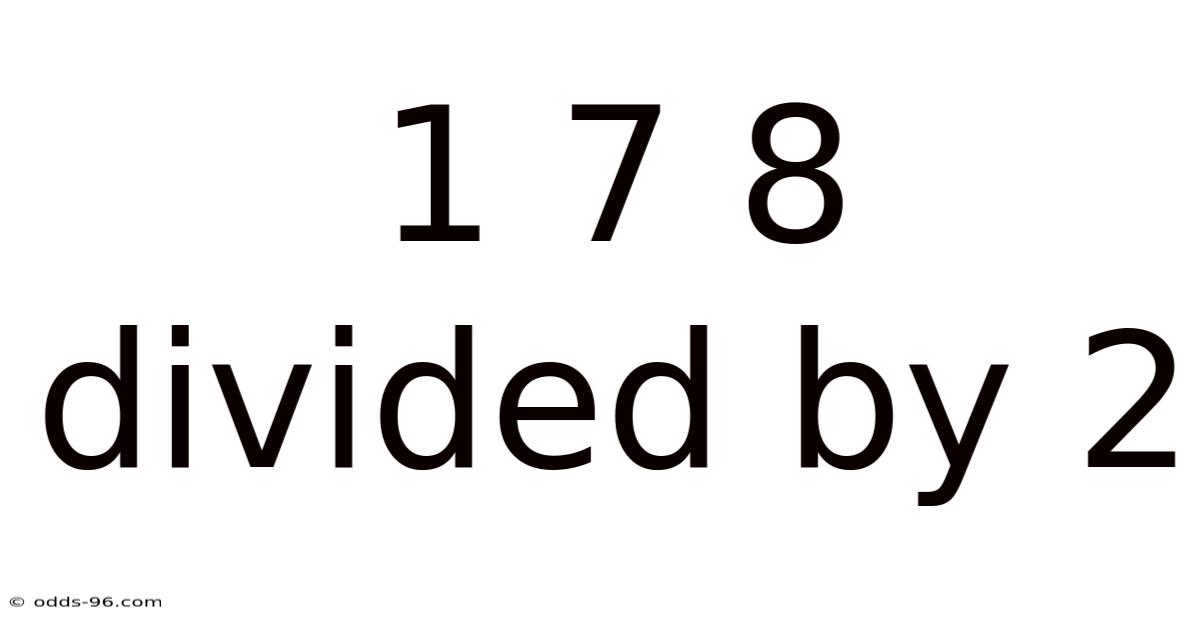
Understanding how to divide mixed numbers is a fundamental skill that bridges the gap between basic arithmetic and more complex algebraic thinking. In practice, the expression 1 7/8 divided by 2 serves as an excellent case study for mastering fraction division, improper fractions, and the concept of reciprocals. Whether you are a student tackling homework, a parent helping with math revision, or an adult refreshing your skills, breaking down this specific problem reveals the logic that governs all fractional division.
Understanding the Problem: What Does 1 7/8 Mean?
Before we can divide, we must clearly understand the components. Consider this: the term 1 7/8 is a mixed number. Here's the thing — it represents a whole quantity (1) plus a fractional part (7/8). Visually, imagine one whole pizza plus seven slices of a second pizza that has been cut into eight equal slices.
This is where a lot of people lose the thread.
In mathematical notation, this is written as $1 \frac{7}{8}$. It is crucial to recognize that the space between the whole number and the fraction implies addition: $1 + \frac{7}{8}$. We are being asked to take this total amount and split it into two equal groups.
$1 \frac{7}{8} \div 2$
Method 1: Converting to an Improper Fraction (The Standard Algorithm)
The most reliable and universally taught method for dividing mixed numbers involves converting the mixed number into an improper fraction first. An improper fraction simply has a numerator larger than or equal to its denominator, representing the total number of "pieces" if the whole items were also cut into those pieces The details matter here..
People argue about this. Here's where I land on it The details matter here..
Step 1: Convert the Mixed Number
To convert $1 \frac{7}{8}$ to an improper fraction, use the standard formula: $ \text{Improper Fraction} = \frac{(\text{Whole Number} \times \text{Denominator}) + \text{Numerator}}{\text{Denominator}} $
Applying this to our problem:
- Plus, add the numerator (7): $8 + 7 = 15$. Multiply the whole number (1) by the denominator (8): $1 \times 8 = 8$.
-
- Keep the denominator (8).
So, $1 \frac{7}{8} = \frac{15}{8}$.
Concept Check: Does this make sense? One whole is $\frac{8}{8}$. Adding $\frac{7}{8}$ gives $\frac{15}{8}$. Yes, it aligns perfectly.
Step 2: Rewrite the Division as Multiplication
Division by a whole number is mathematically equivalent to multiplication by its reciprocal. The reciprocal of a whole number $n$ is $\frac{1}{n}$. So, dividing by 2 is the same as multiplying by $\frac{1}{2}$.
$ \frac{15}{8} \div 2 = \frac{15}{8} \times \frac{1}{2} $
It's often remembered by the mnemonic "Keep, Change, Flip":
- Keep the first fraction ($\frac{15}{8}$).
- Change the division sign to multiplication.
- Flip the second number (2 becomes $\frac{1}{2}$).
Step 3: Multiply Straight Across
Now, multiply the numerators together and the denominators together: $ \frac{15 \times 1}{8 \times 2} = \frac{15}{16} $
Step 4: Simplify (If Necessary)
The resulting fraction is $\frac{15}{16}$. Since 15 and 16 share no common factors other than 1 (15 is $3 \times 5$, 16 is $2^4$), the fraction is already in its simplest form.
Final Answer using Method 1: $\frac{15}{16}$
Method 2: The "Distributive" Approach (Mental Math & Estimation)
For those who prefer to work with the mixed number format without converting to an improper fraction, the distributive property of division over addition offers an intuitive alternative. Since $1 \frac{7}{8} = 1 + \frac{7}{8}$, we can divide each part by 2 separately:
$ \left(1 + \frac{7}{8}\right) \div 2 = (1 \div 2) + \left(\frac{7}{8} \div 2\right) $
Divide the Whole Number Part
$ 1 \div 2 = \frac{1}{2} $ To add this to the fractional part later, it helps to have a common denominator. Since the other fraction has a denominator of 8 (or 16), convert $\frac{1}{2}$ to eighths: $\frac{1}{2} = \frac{4}{8}$.
Divide the Fractional Part
$ \frac{7}{8} \div 2 = \frac{7}{8} \times \frac{1}{2} = \frac{7}{16} $ Alternatively, keep it in eighths by realizing dividing the numerator by 2: $\frac{7 \div 2}{8} = \frac{3.5}{8}$. While valid, decimals in numerators are messy. Sticking to the multiplication by reciprocal ($\frac{7}{16}$) is cleaner.
Add the Results
Now we add the two quotients. We need a common denominator. The denominators are 2 (or 8) and 16. The Least Common Denominator (LCD) is 16.
- Convert $\frac{1}{2}$ to sixteenths: $\frac{8}{16}$.
- The fractional part is already $\frac{7}{16}$.
- Add: $\frac{8}{16} + \frac{7}{16} = \frac{15}{16}$.
Final Answer using Method 2: $\frac{15}{16}$
This method reinforces number sense. It shows that half of "one and a bit" is "half of one" plus "half of the bit."
Method 3: Decimal Conversion (The Calculator Approach)
In real-world applications—like construction, cooking, or finance—converting to decimals is often the fastest route to a usable answer Easy to understand, harder to ignore..
Convert the Mixed Number to a Decimal
$1 \frac{7}{8} = 1 + (7 \div 8)$ $7 \div 8 = 0.875$ So, $1 \frac{7}{8} = 1.875$
Perform the Division
$1.875 \div 2 = 0.9375$
Convert Back to a Fraction (Verification)
To verify this matches our previous answer ($\frac{15}{16}$), divide 15 by 16: $15 \div 16 = 0
.9375$
The decimal result matches perfectly, confirming that $\frac{15}{16}$ is the correct exact value That's the part that actually makes a difference. Turns out it matters..
Final Answer using Method 3: $0.9375$ (or $\frac{15}{16}$)
Summary & When to Use Which Method
All three methods yield the same result: $\frac{15}{16}$ (or $0.9375$). The "best" method depends entirely on the context and your comfort level:
| Method | Best For | Pros | Cons |
|---|---|---|---|
| 1. In real terms, improper Fraction | Algebra, higher math, exact answers required | Standard algorithmic approach; works universally for any fraction division. | Requires conversion steps; slightly more writing. |
| 2. Think about it: distributive Property | Mental math, building number sense, no calculator | Fast for simple divisors (like 2, 3, 4); reinforces conceptual understanding of fractions. Consider this: | Gets messy with complex divisors or large numbers; requires common denominator steps. In real terms, |
| 3. Decimal Conversion | Real-world measurement (inches, mm, currency), calculator use | Fastest for practical applications; easy to compare magnitudes. | Can introduce rounding errors if not careful; converting back to fractions adds a step. |
No fluff here — just what actually works.
A Quick "Sanity Check" for Any Division Problem
Before finalizing any answer, apply a logic check: Dividing by 2 is the same as taking one-half.
- Is the answer roughly half of the original number?
- Original: $1 \frac{7}{8}$ (approx $1.9$).
- Half of $1.9$ is approx $0.95$.
- Our answer: $0.9375$ (or $\frac{15}{16} \approx 0.94$).
- Check passed.
Conclusion
Dividing a mixed number like $1 \frac{7}{8}$ by 2 is a fundamental skill that bridges arithmetic and algebra. Whether you choose the structural reliability of improper fractions, the conceptual clarity of the distributive property, or the practical speed of decimal conversion, the mathematical truth remains constant: half of $1 \frac{7}{8}$ is $\frac{15}{16}$.
Mastering all three approaches ensures you are never stuck—whether you are solving for $x$ in a textbook, calculating a board length in a workshop, or halving a recipe in the kitchen. The numbers don't change; only the tool in your hand does.
